Find some of the most significant benefits of utilizing cloud native computing listed below.
CLOUD-NATIVE TOOLS
Build once, deploy everywhere: that's the essence of cloud-native computing. It makes no difference where it is put into action. Cloud computing enables the construction and operation of scalable applications in dynamic settings such as public, private, and hybrid clouds. Components of this architecture that are commonly used include container vs vm, microservices, serverless functions, and immutable infrastructure, all of which are delivered using declarative code.
These strategies make it possible to move mission-critical applications into multi-cloud systems more quickly while simultaneously improving resiliency, agility, security, and observability. When combined with robust automation, cloud-native computation boosts developer productivity, paves the way for more frequent release cycles, and ultimately reduces the amount of time needed to bring a product to market.

The majority of the time, cloud-native apps are constructed as microservices that are then orchestrated using Kubernetes. These microservices run inside Docker containers. Docker containers separate the application they contain from their environments, which enables the application to be deployed and run in any environment that supports virtualization.
BENEFITS OF CLOUD-NATIVE
1 . Find some of the most significant benefits of utilizing cloud native computing listed below.
2. Improved scalability
3. Time spent in deployment that is cut down
4. Enhanced access is now possible
5. Mobility within the cloud
6. Productivity gains for software developers
7. Cost savings
CLOUD-NATIVE TECHNOLOGY ADOPTION
The results of a survey conducted by the Cloud Native Computing Foundation (CNCF) in 2020 have been used to compile the following summary, which provides an overview of the development of cloud-native technologies, tools, and trends.
KEY FINDINGS
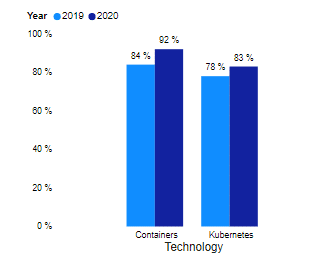
The use of containers in manufacturing has climbed to 92%, which is an increase from 84% the year before and a rise of 300% compared to the results of the first CNCF survey in 2016.
Kubernetes was used in production at a rate of 78% last year, but that number has since grown to 83%.
Utilization of cloud-native tools: o 82 percent of respondents use continuous integration and continuous delivery pipelines in production.

o Thirty percent of respondents make production use of serverless technology.
o A service mesh is used in production by 27% of respondents, which is a 50% increase from the previous year.
o Fifty-five percent of respondents make use of stateful applications in production containers
WHICH CLOUD?

The public Cloud enterprise services is the most popular, while the private cloud is experiencing rapid expansion. A recently developed alternative known as MultiCloud is being utilized by 26% of users.
TRANSMISSION CYCLE
The number of people who publish new software once every day, several times per day, once per week, or once per month is growing at a steady rate. 53% of users check in code numerous times per day, whereas 80% of users check in code at least several times each week. Complexity, a lack of experience, and resistance are three of the primary reasons why many businesses are not yet prepared to transition to completely automated processes.
THE USE OF RECEPTACLES
The use of containers as the primary packaging method has become the industry standard.
A survey conducted by the CNCF reveals that the use of containers is continuously growing. It has evolved into the industry standard for use in production applications. Over the course of the previous four years, there has been a startling spike of 300% in the utilization of containers. The survey also reveals that 95 percent of respondents use containers when developing PoC (Proof of Concepts), test, and production environments. This indicates that businesses are experimenting with novel use cases and preparing to transfer more workloads into containers.
The Problems With Containers
Although containers are quickly becoming the industry standard, there are still several obstacles to overcome before successfully designing and deploying containers.
The difficulty, as well as the steep learning curve
Resistance to cultural shifts and developments
Insufficiently trained resources and personnel in general
Logging & Monitoring
Persistent storage
Implementing The capabilities of Scalability, Reliability, and Security
deciding on the appropriate instruments.
Locating the most suitable provider
ORCHESTRATION
The show is directed by Kubernetes. The results of a survey conducted by CNCF showed that the majority of respondents (91%) use Kubernetes, with 83% of them using it in production. The percentage of organizations that use Kubernetes has been steadily climbing over the past few years (78% in 2019, up from 58% in 2018). The ecosystem that surrounds Kubernetes is expanding at the same rate as Kubernetes itself. Namespaces continue to be the most common method for separating apps running on Kubernetes. The percentages are now projected to be 84% in 2020, up from 75% in 2019.
The poll found that Minikube (37%), on-premise Kubernetes deployments (31%), and Docker Kubernetes (29%) are the most common types of Kubernetes setups. The number of on-premises Kubernetes installations rose to 31% from 23% the previous year.
The number of production environments that make use of containers and Kubernetes continues to rise.
CLOUD-NATIVE TOOLS
According to the findings of the survey, CI/CD is utilized extensively (82%) in production environments, and many more organizations are examining its viability and making plans to implement it. Jenkins, GitLab, and GitHub Actions are now the three most popular CI/CD tools. It has also been discovered that Flux and Helm are the CD tools that are utilized the most frequently.
In order to improve observability, monitoring, logging, and tracing are very necessary. These needs are currently being met by companies using a variety of tools. Open-source options, such as Prometheus, Grafana, and Elastic, are by far the most common and widely used alternatives. Monitoring, logging, and tracking are typically carried out by the vast majority of businesses via some combination of the aforementioned instruments.
The application's speed can be optimized and the management of interactions between microservices can be simplified with the help of a service proxy. According to the poll, 37% of respondents are now making use of a service proxy in production, and many more are investigating the possibility of doing so and making plans to implement it in the near future. Proxy servers such as Nginx, Envoy, and HAProxy are among the most widely used.
Containers were initially designed to have no fixed location so that their contents could be easily moved from one location to another. However, the number of stateful applications that run inside containers is experiencing meteoric growth right now. Stateful applications are being used in production environments by an increasing number of organizations, and many more are assessing stateful computing and getting ready to implement it in production settings. The results of the survey indicate that Google cloud Kubernetes, Persistent Disk (81%), Amazon Elastic Block Storage (EBS) (80%), and Azure Disk Storage (74%), are the top three cloud native storage projects that are currently being used in production.
The use of computer models that do not require servers is gaining popularity. According to the results of the poll, thirty percent of respondents currently make use of serverless computing, while another twenty-one percent are currently evaluating it and fourteen percent have future plans to do so. Hosted platforms are utilized by the vast majority of users of serverless technology. AWS Lambda, Google Functions, and Azure Functions are the ones that are used the most.
The survey also revealed that the utilization of Service Mesh in production has increased by fifty percent. 27% of companies are currently using service mesh in production, 23% are exploring it, and 19% have plans to utilize it within the next year.
SUMMARY
The CNCF Survey 2020 serves as the primary research for this article, which focuses mostly on cloud-native technologies and trends. I'll give you a taste of where cloud-native computing is headed, as well as an idea of how quickly it's being adopted.


Comments
Post a Comment